





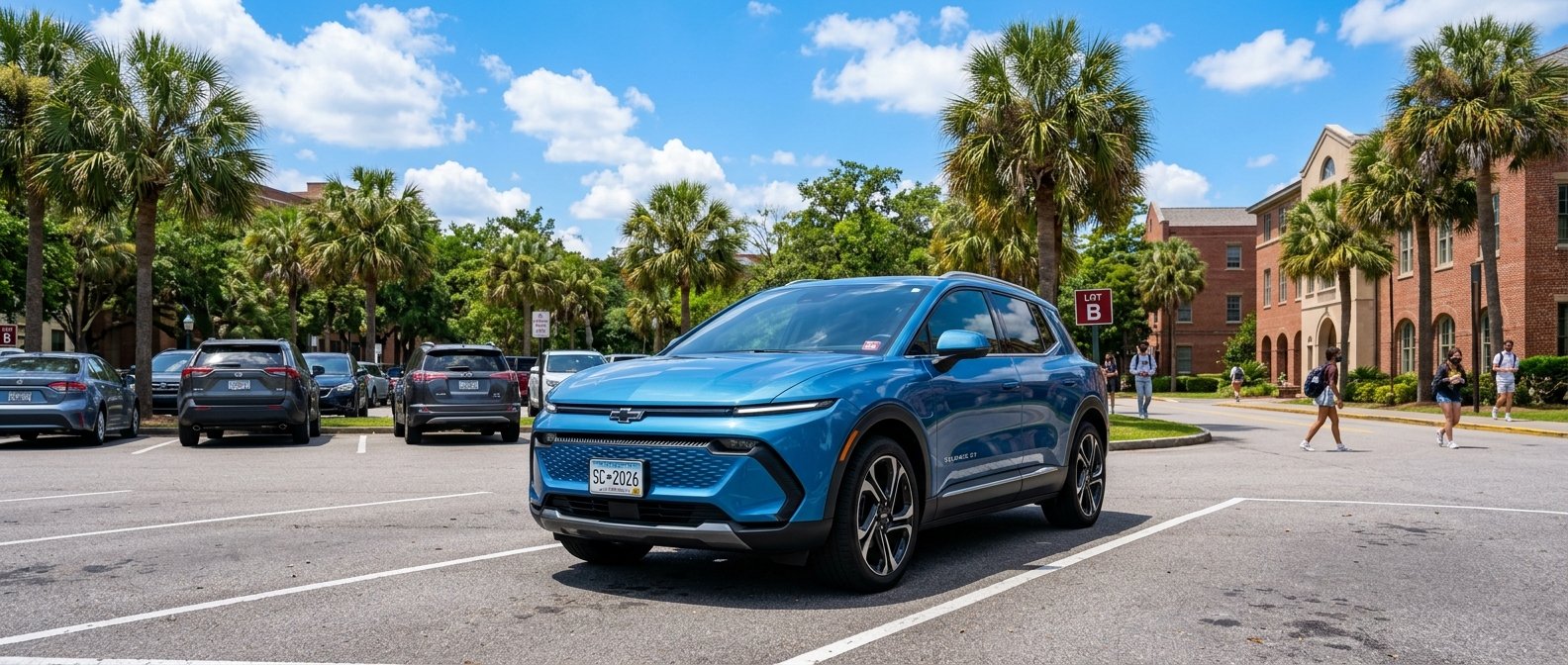
You’re leaving Conway on a Friday afternoon. The luggage is piled by the door, the kids are already in the car arguing over playlists, and US-501 is about to get interesting. The right Chevy SUV handles all of that without drama. A wrong fit turns a good trip into a headache somewhere past the Waccamaw River bridge, and so can a skipped prep step.
Want the short answer first? The 2027 Chevrolet Equinox is the road-trip pick for solo drivers and couples who want to stretch their fuel dollar. For the full crew and all the cargo, the 2027 Chevrolet Traverse is your three-row family hauler. When there’s a boat trailer in the picture, the 2027 Chevrolet Tahoe is the right answer. Once you know which one fits your trip, the checklist below gets it ready to roll.
What Goes on the Checklist?
Everything on this list earns its place before you back out of the driveway, and we’ve grouped it by category so you can print the page, fold it in half, and check items off at the lot or in the garage without losing your spot.
Vehicle Match (Do This First)
- [ ] Confirm passenger count. The 2027 Traverse seats seven standard, or eight with the optional second-row bench on the LT. If you have six or more people, the Equinox simply doesn’t fit the trip.
- [ ] Confirm cargo needs. Chevrolet lists the 2027 Traverse at up to 97.6 cubic feet of maximum cargo space. The 2027 Equinox tops out at 63.5 cubic feet. That gap matters when you’re loading a pack-n-play, a cooler, and three full-size suitcases.
- [ ] Confirm towing needs. Pulling a jon boat or a small camper? The 2027 Tahoe, properly equipped with the Max Trailering Package and 5.3L V8, is rated by Chevrolet at up to 8,400 pounds of towing capacity. Properly equipped, the Traverse handles up to 5,000 pounds. The Equinox tows 1,500 pounds. Know your trailer weight before you hitch.
- [ ] Skip AWD if you’re staying coastal. We say this one plainly on the lot, because South Carolina coastal roads don’t ask for all-wheel drive. The EPA rates the 2027 Equinox FWD at 26 city / 29 highway mpg. Step up to AWD and that drops to 25 city / 29 highway. On the 2027 Traverse the spread is wider. FWD gets 20 city / 27 highway, and AWD drops to 19 city / 24 highway. Over a 700-mile weekend, that’s a real difference. Save AWD for the mountains.
Fluids and Tires
- [ ] Check tire pressure. The EPA’s own guidance notes that underinflated tires increase rolling resistance and lower fuel economy. Use the placard spec on your Chevy’s driver’s door jamb. The number molded into the tire sidewall is only the maximum rating.
- [ ] Verify oil life monitor. Chevrolet’s oil life monitoring system is percentage-based, not mileage-based. If it’s below 20%, book the oil change before you leave rather than waiting until you’re back.
- [ ] Top off washer fluid. Coastal SC in late summer means bugs and humidity. You’ll use more than you think.
- [ ] Check coolant level. A hot engine in stop-and-go beach traffic needs a full reservoir.
Tech and Safety Systems
- [ ] Pair your phone via wireless Apple CarPlay or wireless Android Auto. All current Chevy SUVs include both as standard. Set it before you pull out of the driveway so you’re not fiddling at the first stoplight.
- [ ] Calibrate your destination in Google Maps or Waze before the trip. Veterans Highway, also called SC-22, bypasses US-501’s worst Saturday congestion and runs you straight from the US-501 corridor near Aynor directly to the north end of Myrtle Beach. If your nav app doesn’t know your habits, it defaults to 501 and you sit in the tourist wave. Tell it your preferred route before you leave.
- [ ] Test the backup camera. Standard on every Chevy SUV in the lineup. If the lens is dirty, and it will be after a coastal summer, clean it now.
- [ ] Confirm Forward Collision Alert and Automatic Emergency Braking are active. These are standard on the 2027 Equinox and 2027 Traverse. Check the Driver Assistance menu in the infotainment screen to make sure neither was accidentally turned off.
Cargo and Comfort
- [ ] Load heavy items low and forward. Physics doesn’t negotiate. Keep weight toward the floor and toward the front seats for the flattest handling.
- [ ] Pack a reusable grocery bag for beach gear. Sand gets into everything. One bag by the door means towels and flip-flops don’t migrate to the cargo area permanently.
- [ ] Charge devices before departure. The Traverse and Equinox both include USB-A and USB-C ports. Know which devices need which cable before the kids ask you mid-trip.
Fuel Range Planning
- [ ] Calculate your highway range. The 2027 Equinox FWD carries a 14.9-gallon tank. At an EPA-estimated 29 mpg highway, that’s roughly 432 miles of highway range before the low-fuel light becomes urgent. The 2027 Traverse FWD holds 19.4 gallons; at 27 mpg highway, you’re looking at around 524 miles of range. Plan your stops around those numbers, not around habit.
- [ ] Note fuel grade. All three SUVs covered here run on regular 87-octane. You don’t need premium. Don’t let a station upsell you.
Schedule a Pre-Trip Service Check
Why Each Item Matters for a Grand Strand Road Trip
Every item on that checklist ties back to a real condition Conway-area drivers hit on the way out of Horry County, so nothing on it is filler, and each line reflects the coastal heat, flat terrain, or traffic pattern you’ll actually meet.
The tire-pressure check matters more here than in most markets. Coastal SC heat, routinely above 90 degrees Fahrenheit from June through September, causes air to expand inside tires, but beach parking lots and slow beach-road traffic generate enough sidewall heat that underinflation is the variable to watch. The EPA notes that proper tire inflation is one of the most consistent factors in maintaining rated fuel economy.
The AWD question on coastal trips:
- Stays mostly at sea level on flat coastal plain.
- Roads are straight and mostly dry, apart from summer thunderstorms.
- AWD makes sense heading to the Upstate, Blue Ridge, or Smokies.
- Doesn’t make sense for the Myrtle Beach run or Charleston route down US-17.
- FWD is the fuel-smart default for the Conway market.
For couples and solo travelers doing 400 to 500 miles round-trip who want the best efficiency in the Chevy SUV lineup, the Equinox is the right call. At an EPA-estimated 26 city / 29 highway mpg on FWD, it’s a genuinely efficient compact crossover for the kind of trip a Conway driver actually takes, whether that’s down US-501 to Myrtle Beach, out to a barrier island, or up to Wilmington, NC, for a long weekend.
Where the Equinox runs out of room, the Traverse seats a full crew and carries everything they brought. Chevrolet lists the 2027 Traverse at 41.4 inches of second-row legroom and 32.1 inches in the third row. That third row is usable for adults on shorter legs (not a penalty box), which is a real distinction in the midsize three-row class. A 17.7-inch touchscreen and wireless device integration keep the back seat entertained. The 328-horsepower 2.5-liter turbocharged four-cylinder gives you confident passing on US-378 and SC-22 even with seven aboard.
The Tahoe earns its spot on a road trip only when something is attached to the back. Its 5.3L V8 produces 355 horsepower and 383 lb-ft of torque, and Chevrolet’s 24.0-gallon fuel tank means the V8, EPA-rated 15 city / 20 highway on the 5.3L RWD, can still cover roughly 480 highway miles per fill. If you’re pulling a boat to a South Carolina lake, a pop-up camper to the mountains, or a trailer of equipment to a job site, the Tahoe is the only one of these three that does it at scale.
| SUV | Best-fit trip | Max cargo | Tow rating | Highway MPG (FWD/RWD) |
|---|---|---|---|---|
| 2027 Equinox FWD | Couple or solo, 400-500 mi round-trip | 63.5 cu ft | 1,500 lbs | 29 mpg (EPA) |
| 2027 Traverse FWD | Family of 5-8, beach/mountains, light trailer | 97.6 cu ft | 5,000 lbs | 27 mpg (EPA) |
| 2027 Tahoe 5.3L V8 | Boat or camper in tow, family-size cabin | 122.9 cu ft (all rows folded) | 8,400 lbs (properly equipped) | 20 mpg (EPA) |
Our service team can inspect tires, fluid levels, and brake condition before your trip, all in one stop.
Your Print-and-Go Road-Trip Recap
You don’t have to reread the entire post before you leave, since the recap below boils it down to four moves you can run right in the driveway, and getting those four right is what keeps a Grand Strand run smooth instead of a roadside scramble past the Waccamaw River bridge. Tear this off mentally and bring it to the driveway.
Pick the right SUV first. Equinox for two, Traverse for seven, Tahoe for the trailer. Everything else is downstream of that decision.
Check the four things that actually affect your trip. Set tire pressure to the door-jamb spec, confirm oil life is above 20%, plan fuel range around your tank size and EPA highway number, and get your tech set up, meaning CarPlay or Android Auto paired before departure and the nav route confirmed for the SC-22 bypass if you’re heading to the beach on a Saturday.
Don’t pay for AWD you don’t need. For a coastal SC trip, FWD is the rational choice. The fuel penalty is real and the traction benefit on flat coastal highways is minimal.
Book a service check before the long run. Our team at Palmetto Chevrolet in Conway can knock out a multi-point inspection quickly, and catching a low brake pad or a slow tire leak before the trip is a lot more convenient than catching it on US-501 with a car full of people.
Frequently Asked Questions
Is the 2027 Traverse a better road-trip vehicle than the Tahoe for a Conway family?
For most Conway families who aren’t towing, yes. The 2027 Traverse seats up to eight, carries 97.6 cubic feet of maximum cargo, and is rated by the EPA at 27 mpg highway on FWD. The Traverse’s number is meaningfully better than the Tahoe’s EPA-rated 20 mpg highway with the 5.3L V8. The Tahoe earns its place when you have a boat, a camper, or a large trailer. Without a tow need, the Traverse’s size, third-row legroom, and fuel economy are more practical for the typical Grand Strand trip.
Do I need AWD for driving from Conway to the mountains or the Upstate?
Your answer depends on the season and the destination. For a summer or fall trip to the Upstate or toward the Blue Ridge, AWD gives you meaningful traction benefit on wet mountain roads and any gravel surfaces. For a coastal trip staying on the Grand Strand, it’s an unnecessary fuel cost. The 2027 Equinox FWD is rated 26 city / 29 highway mpg; the AWD version is 25 city / 29 highway. On the 2027 Traverse, FWD is 20 city / 27 highway, AWD is 19 city / 24 highway. Know your destination before you choose your drivetrain configuration.
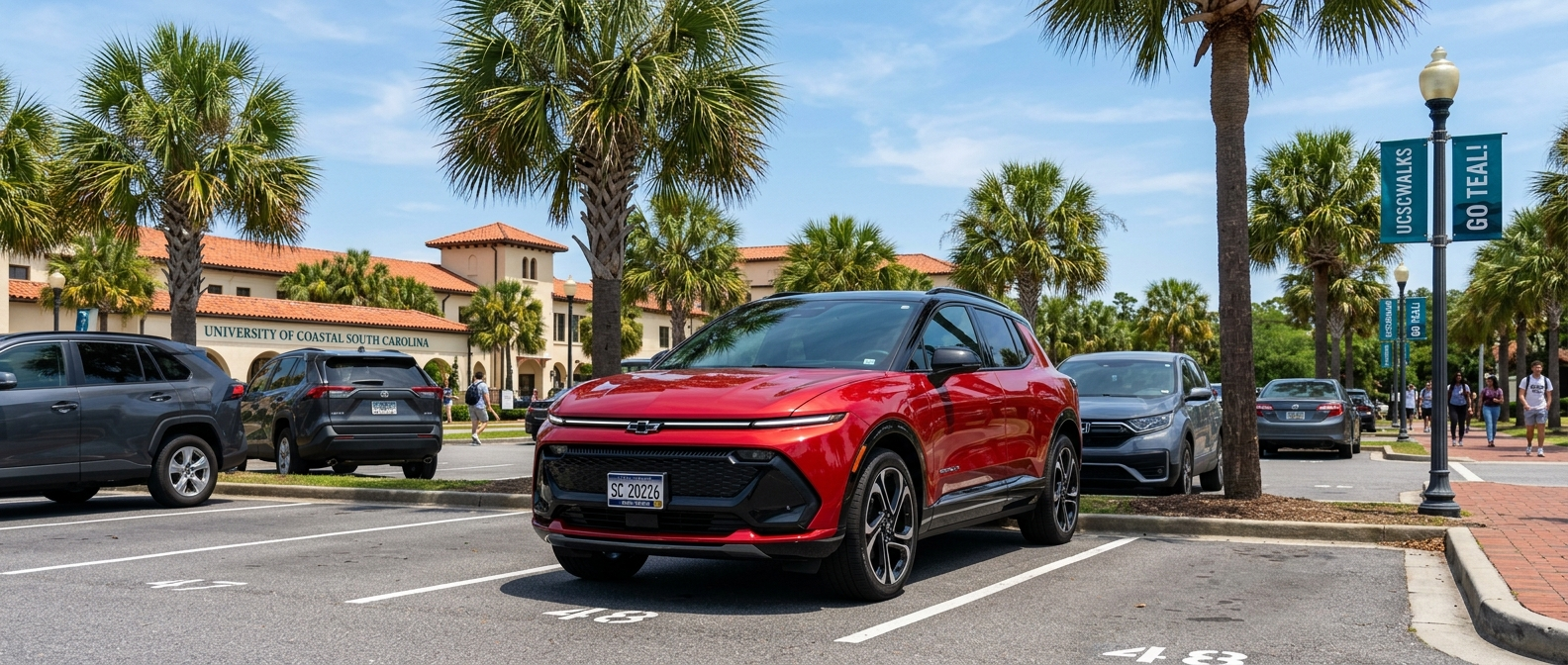
When a CCU faculty or staff member walks in wanting something practical for the campus commute, easy to slot into a tight university parking lot, and useful enough on weekends that they don’t feel shortchanged, our honest answer is the 2026 Chevy Equinox. The LT trim is the one we’d send most of you home in, and it’s the strongest all-around value in the lineup. Full stop. That said, there are two situations where stepping up to the RS or the Activ makes real sense for this market, and we’ll show you exactly when.
We built the ranking below around three criteria that matter to CCU staff specifically. First is daily commute efficiency on US-501 and the Conway surface streets. Second is the practical reality of parking at the 3,300-space campus, where tight spots are a fact of life. Third is enough weekend versatility to make the Equinox earn its keep past 5 p.m. on Fridays.
2026 Equinox Trim Rankings for CCU Staff
| Rank | Trim | Best For | Standout Spec |
|---|---|---|---|
| 1 | Equinox LT (FWD) | Daily commuter, value-focused faculty | EPA-rated 26 city / 29 hwy / 27 combined mpg |
| 2 | Equinox RS (AWD) | Staff who run longer Grand Strand routes and want sport styling | 203 lb-ft torque; dual-zone climate standard |
| 3 | Equinox Activ (AWD) | Outdoor-lifestyle staff, occasional off-pavement weekend use | All-terrain tires + lifted suspension standard |
Equinox LT: The Right Call for Most CCU Commuters
For most CCU commuters the LT in front-wheel drive is the right call, since flat coastal South Carolina is genuinely not AWD country, and it earns a Chevrolet-listed EPA rating of 26 city / 29 highway / 27 combined mpg. You do trade away the visual presence the RS and Activ carry. Conway sits at roughly sea level, US-501 runs straight and flat, and the campus loop roads on SC-544 don’t throw anything at you that FWD can’t handle. Every fill-up on a 14.8-gallon tank punches up to 429 highway miles. For someone making a 10-to-20-minute commute from a Conway neighborhood to campus five days a week, that fuel economy adds up.
The LT doesn’t short you on tech or safety. Every 2026 Equinox, regardless of trim, ships with an 11.3-inch touchscreen running Google Built-In, wireless Apple CarPlay and Android Auto, heated front seats, a heated steering wheel, and remote start. Chevy Safety Assist is standard across the board too, with six active safety systems including Automatic Emergency Braking, Front Pedestrian Braking, Lane Keep Assist with Lane Departure Warning, and a Following Distance Indicator. You don’t have to buy up for any of that. The Equinox EV is worth knowing about as well, especially since CCU’s campus already offers free EV charging for faculty and staff, and vehicles must be moved within two hours of a full charge. If you’re thinking long-term, ask us how that option fits your routine.
The LT’s honest tradeoff is that it’s the plainest-looking trim in the lineup, and the RS and Activ carry more visual presence. If that matters to you it matters, but if you’re prioritizing ownership value and monthly predictability, the LT FWD is the one.
Equinox RS: For Staff with a Longer Commute or a Lifestyle Upgrade in Mind
Step up to the RS when your commute runs long or a lifestyle upgrade appeals to you. It adds dual-zone automatic climate control, Evotex seating, and sportier interior trim that pays off over 30 or 40 minutes each way, though a five-minute Conway hop won’t let you feel most of it. Some of you commute from Myrtle Beach, Socastee, or further east along the Grand Strand, and that longer run changes the calculus. The refinement adds up when you’re spending real time in the seat.
Underneath, the structural difference is real. Opting for AWD on the RS swaps the CVT for a proper 8-speed automatic and bumps torque from 184 lb-ft to 203 lb-ft, per Chevrolet’s specs. Highway fuel economy stays right there at 29 mpg even with AWD added. The system runs primarily in front-wheel-drive mode and only brings the rear axle in when traction demands it. So you’re not burning much more fuel in AWD for the kind of steady highway driving most Grand Strand commutes involve. What you’re buying is a more refined driving feel and a little extra confidence on wet pavement during the afternoon thunderstorms that run near-daily from June through September on the coast.
If you want a sportier footprint with a bit more presence, the Equinox RS threads the needle between compact maneuverability in the campus lots and a satisfying longer commute better than most in its class.
Pros and Cons: 2026 Equinox for the CCU Staff Buyer
| Pros | Cons |
|---|---|
| Standard Chevy Safety Assist on every trim (six active safety features, no package required) | No hybrid option in the gas Equinox lineup |
| EPA-rated 27 mpg combined (FWD) for the daily Conway commute | Activ’s all-terrain tires add rolling resistance; fuel economy nudges down vs LT |
| 29.8 cu ft of cargo behind the rear seats; 63.5 cu ft folded (room for a weekend worth of gear) | Cargo is smaller than the Traverse if you routinely carry a lot |
| 11.3-inch Google Built-In touchscreen and heated seats standard across all trims | CVT on FWD feels less sporty than the AWD’s 8-speed automatic |
| Compact 183-inch overall length fits the tighter faculty and staff parking spots on campus | No third-row option for larger households |
Equinox Activ: When the Weekend Does More Than Myrtle Beach
The Activ earns its spot when your weekends involve gravel, sand, or unpaved access roads. It brings standard AWD, all-terrain tires, and a slightly raised suspension, though it stays a compact crossover and won’t pretend to be a trail-rated off-roader. Picture the CCU staff member who runs weekend trips to Francis Marion National Forest, keeps a kayak in the garage, or routinely drives the boat-ramp access roads along the rivers and marshes that crisscross Horry County. The Activ comes with AWD standard, so there’s no option decision to make, plus all-terrain tires and a slightly raised suspension. It’s still a compact crossover, not a trail-rated off-roader, so don’t confuse it with something it isn’t. But on the gravel, hard-packed sand, and occasional muddy lot that coastal SC throws at you seasonally, the Activ’s setup is more capable than the LT or RS on standard rubber.
You give up nothing on space by choosing the Activ. Cargo runs 29.8 cubic feet behind the rear seats, or 63.5 with the seats folded, per Chevrolet’s specs, and that’s the same across all three trims. Interior passenger volume of 104.3 cubic feet means four adults sit comfortably for a longer drive, and the Activ simply dresses the package with more outdoor intention. Rear legroom checks in at 39.9 inches, Chevrolet-listed, so a colleague riding shotgun in back isn’t folded up for the ride to a campus event across town.
If none of that outdoor-weekend life describes you, stepping up to the Activ isn’t money well spent. The LT does everything a straight commuter and light-errand driver needs. But if the Francis Marion runs or the Waccamaw riverbanks are part of your routine, the Activ is the one that won’t frustrate you when you get there.
Browse pre-owned Equinox inventory
Get Pre-Approved for Financing
The Bottom Line for CCU Staff
For most of you the LT is the pick, thanks to Conway’s flat coastal terrain, the short-to-medium campus commute, and the Equinox LT’s EPA-rated 27 combined mpg in FWD. The RS and Activ stay reserved for longer commutes and genuine weekend terrain. You get the full Chevy Safety Assist suite, Google Built-In, heated seats and wheel, and 29.8 cubic feet of cargo room behind the seats, all from the entry trim. Move up to the RS if your commute is longer, you want AWD confidence on Grand Strand wet-weather days, or the interior step-up matters to you. Choose the Activ if weekend coastal terrain, gravel, or boat-ramp access is a real part of your life, not just hypothetical.
We’re right here in Conway, about as close to campus as a dealership gets. Come by, take one out on US-501, and see which version of the 2026 Equinox fits the actual shape of your week.
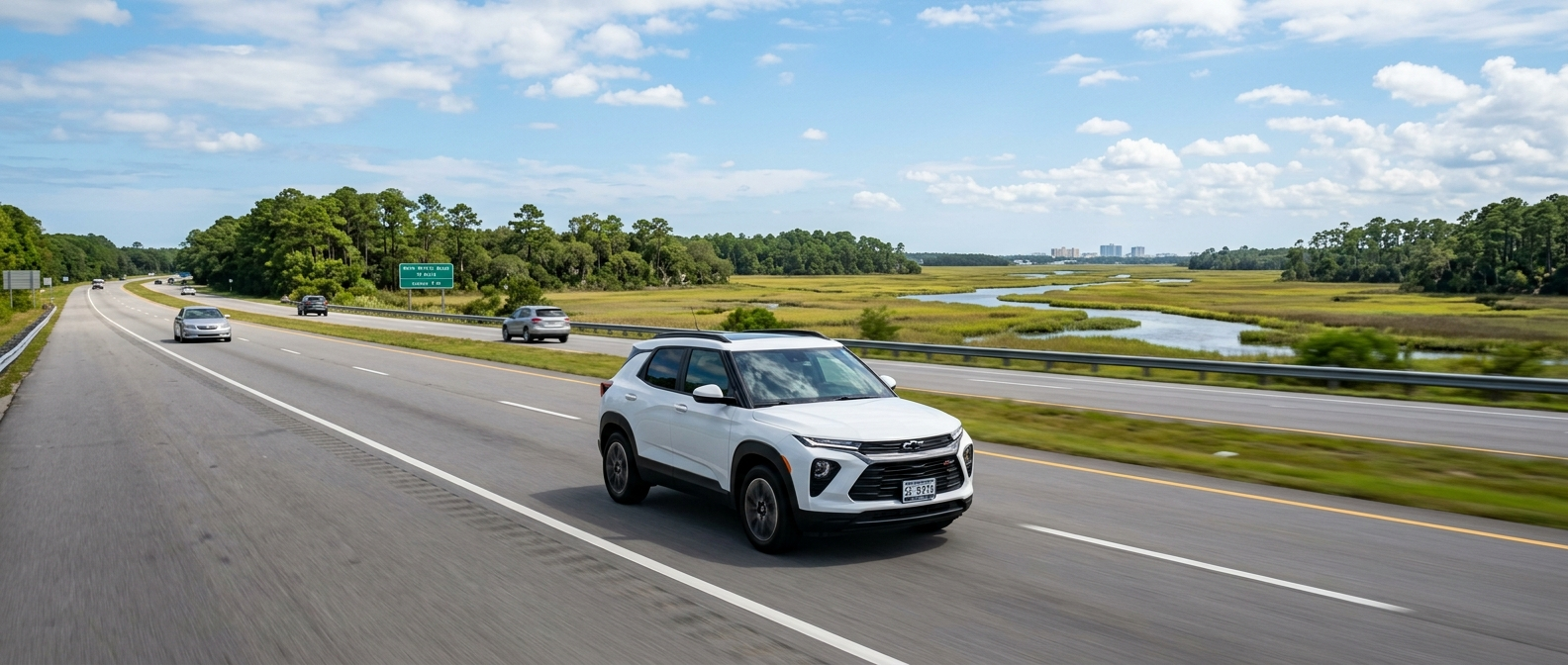
Yes, and here’s the specific reason it works for this corridor. SC-31 (the Carolina Bays Parkway) is a 65-mph, red-light-free, limited-access highway where the 2026 Trailblazer’s 1.3L FWD configuration earns up to 33 mpg on the highway. Add standard automatic emergency braking for the merge-heavy summer beach runs, and it’s a capable, honest fit for Horry County’s main artery. The genuine tradeoff is cargo and cabin size for larger families.
See the 2026 Trailblazer at Palmetto Chevrolet
Which Trailblazer Trim Makes the Most Sense for SC-31 Drivers?
For most Conway-area drivers the LT front-wheel-drive with the 1.3L engine is the trim that fits, and the reason comes down to how SC-31 actually drives rather than any single spec, because this corridor rewards steady highway cruising over trail capability and rewards good merging tech over off-road hardware. SC-31 runs 28 miles, a six-lane freeway from SC-707 near Socastee north to SC-9 in Little River, paralleling the Intracoastal Waterway. So you’re looking at sustained highway speeds, not twisty back roads. You’re also merging into heavy beach-season traffic at interchanges with US-501 and SC-22. Those two facts point to one trim.
| Trim | Engine | Drivetrain | EPA Highway MPG | Best For on SC-31 | Honest Tradeoff |
|---|---|---|---|---|---|
| LS | 1.2L Turbo I-3, 137 hp | FWD (CVT) | 31 mpg hwy | Budget-conscious solo/couple runs | No blind-spot monitoring standard |
| LT | 1.2L or 1.3L Turbo, 137-155 hp | FWD or AWD | 31-33 mpg hwy (FWD 1.3L) | Daily Conwy-to-beach commuters, remote start in summer heat | AWD drops to 29 mpg hwy |
| ACTIV | 1.3L Turbo, 155 hp | FWD or AWD | 33 mpg hwy (FWD) | Families wanting ride height (8 in. ground clearance AWD) and rugged look | Costs more than needed for flat Lowcountry roads |
| RS | 1.3L Turbo, 155 hp | FWD or AWD | 33 mpg hwy (FWD) | Buyers who want adaptive cruise for long SC-31 runs + sporty interior | 19-inch wheels feel every expansion joint on the parkway |
The LT FWD with the 1.3L engine is where we’d steer most Conway-area buyers. You get the EPA-rated 33 mpg highway from Chevrolet on the run up to North Myrtle Beach, remote start for the brutal late-summer heat in the parking lot, and the option to add blind-spot monitoring for those busy SC-22 merge points. In beach-season traffic, that adds up.
Traveling with more passengers? See the Traverse
Does the Trailblazer Handle Beach-Season Traffic and Summer Heat on SC-31?
Yes, the 2026 Trailblazer handles both the stop-and-go and the heat well, with standard driver-assist tech for the traffic and standard remote start on most trims for the heat, though summer genuinely changes the job description because SC-31 in June through August is a very different animal than SC-31 in October. The US-501 interchange backs up fast when the beach-season weekend crowd hits, and the June-September heat in Horry County runs consistently brutal on sitting vehicles. Two things address this head-on.
First, Chevrolet lists Chevy Safety Assist as standard on every 2026 Trailblazer trim. The list covers Automatic Emergency Braking, Front Pedestrian Braking, Lane Keep Assist with Lane Departure Warning, and Forward Collision Alert (all active at highway speeds where drivers tend to relax into cruise control on the open parkway and then get caught at a merging interchange). The RS and higher LT packages add Adaptive Cruise Control, which really reduces fatigue on the 28-mile corridor.
Second, remote start comes standard on the LT, ACTIV, and RS, and it matters in a Conway parking lot in August. Starting the Trailblazer from inside and letting the air conditioning run before you climb in isn’t a luxury in coastal South Carolina. Call it a practical feature that earns its keep from about May through September.
The honest limit is size and cargo. The Trailblazer’s 13.2-gallon tank means a full fill-up covers about 435 miles on the highway with the FWD 1.3L (Chevrolet/EPA), so fuel stops aren’t a concern for any Horry County trip. Cargo runs tighter. Cargo space behind the rear seats is 25.3 cubic feet, and folding the rear seats grows that to 54.4 cubic feet. A beach day for two fits easily. Load in four adults plus coolers and chairs and it gets cramped.
Browse current Trailblazer inventory at Palmetto Chevrolet
Is AWD Worth It for the Lowcountry, or Can You Skip It on SC-31?
For most buyers you can comfortably skip AWD on SC-31, though there’s a narrow set of real conditions where it genuinely pays for itself, so the answer isn’t a flat no as much as a mostly no with a couple of real exceptions worth naming. SC-31 is flat, paved, and well-maintained. Horry County doesn’t see ice or snow in most winters. The situation where AWD earns its money here is wet-pavement lane changes on the parkway during a July afternoon thunderstorm, or backing a light trailer off a sandy boat ramp on the Waccamaw River. If neither of those describes your week, FWD saves you about six highway mpg.
For buyers who do want the extra grip, the 2026 Trailblazer AWD pairs exclusively with the 1.3L turbo and the 9-speed automatic (replacing the CVT), and Chevrolet rates it at 26 mpg city and 29 mpg highway. The 9-speed automatic is a better transmission than the CVT for feel, though the CVT is more efficient. Worth knowing if drivability matters to you as much as fuel economy does.
The ACTIV AWD trim gets eight inches of ground clearance from Chevrolet’s specs. If you’re pulling off SC-544 toward a boat launch or a hunting club road near Conway, that extra clearance and the AWD together make sense. For a straight SC-31 to North Myrtle Beach commuter run, they’re solving a problem you don’t really have.
Ready to talk numbers? Start with Palmetto Chevrolet financing
Frequently Asked Questions
Is the 2026 Chevy Trailblazer big enough for a beach trip from Conway to North Myrtle Beach?
The answer depends on your crew. The 2026 Trailblazer seats five and offers 25.3 cubic feet of cargo behind the rear seats, growing to 54.4 cubic feet with the rear seats folded (Chevrolet). A couple with beach chairs, a cooler, and bags fits easily. Four adults with a full day’s gear is manageable but snug. If you’re regularly running a family of five or six with serious luggage, the Traverse or a larger SUV is the more comfortable answer.
Do I need AWD for driving SC-31 and the Grand Strand area?
For most Grand Strand drivers, no. SC-31 is a flat, six-lane limited-access highway with no significant elevation changes. Horry County winters are mild and rarely see ice. AWD on the 2026 Trailblazer costs roughly six highway mpg compared to the FWD 1.3L configuration. If you frequently use unpaved boat ramps, sandy access roads, or flooded back roads during hurricane season, AWD is worth considering. For daily Conway-to-beach commuting on SC-31, FWD is the practical choice.
Which 2026 Trailblazer trim has the best safety tech for SC-31 merge traffic?
Every 2026 Trailblazer trim includes Chevy Safety Assist with Automatic Emergency Braking, Forward Collision Alert, and Lane Keep Assist. The LT adds blind-spot monitoring and rear cross-traffic alert, which are directly useful at the SC-22 and US-501 interchanges where lanes merge and exit at speed. The RS adds Adaptive Cruise Control, which reduces fatigue on longer SC-31 highway segments. For most buyers, the LT’s safety package is the sweet spot for this corridor. By the Palmetto Chevrolet Team | September 2026
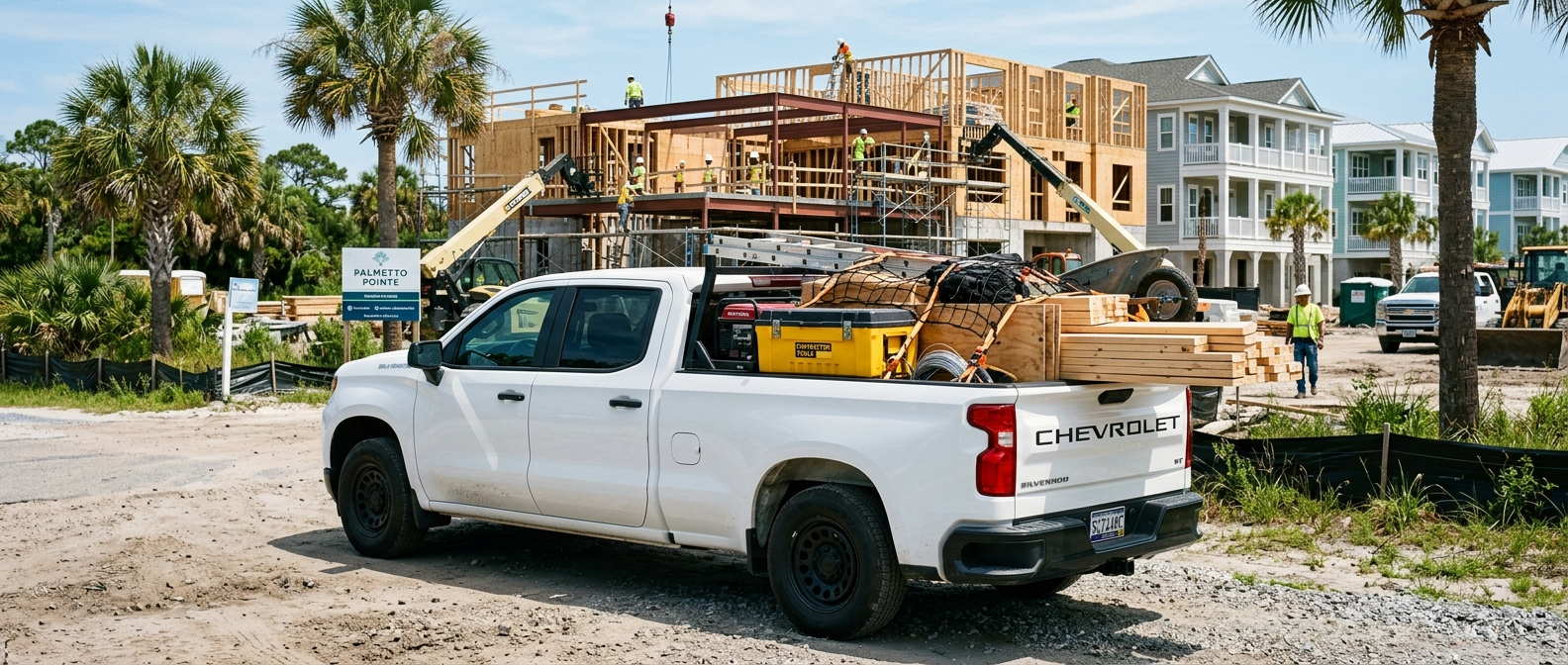
Working near Market Common is nothing like a suburban cul-de-sac build. You’re on a 114-acre former air force base that was redeveloped into a pedestrian-first urban village, with tight parking lanes, active retail nearby, and a property management culture that notices oversized equipment fast. At the same time, Horry County issued more than 3,600 residential permits in 2026 alone, and the county’s construction sector has grown by more than 18 percent over the past five years. Contractors here aren’t running one job. They run several at once, every week.
The right Chevrolet truck for that reality isn’t one answer. It depends on your payload, your trailer, and whether you’re threading between parked cars on a mixed-use site or hauling heavy gear across US-501 to a Carolina Forest framing job.
See our 2026 Silverado 1500 inventory at Palmetto Chevrolet and use the filter to find Work Truck and LT trims built for the job.
Which Chevy Truck Actually Fits a Coastal Job Site?
The truck that fits a coastal job site depends on how and where you’re hauling, because contractors around the Grand Strand face a set of conditions that most truck guides, written for something like a Texas ranch operation, just don’t address the way our local sites demand. Below is how the three core Chevrolet work trucks stack up against what you’ll actually meet between Conway and the Myrtle Beach waterfront.
| Local Condition or Use | The Feature That Handles It | Why It Matters Here |
|---|---|---|
| Tight Market Common delivery zones and urban parking | Silverado 1500 Double Cab footprint | Shorter than HD trucks, easier on restricted access sites without sacrificing a full 8-ft bed option |
| Hauling drywall, lumber, or HVAC equipment to a residential build | Silverado 1500 payload up to 2,260 lb (properly equipped) | Covers most solo sub loads without an HD purchase |
| Moving equipment trailers between multiple Horry County sites | Silverado 1500 towing up to 13,300 lb (properly equipped) | Pulls a loaded equipment trailer across US-501 without needing a 2500 |
| Heavy concrete, steel, or multi-trailer rigs on longer hauls | Silverado 2500 HD with Duramax 6.6L diesel, 975 lb-ft torque, up to 18,500 lb towing | When the load exceeds a half-ton’s limit, this is the only answer. No workaround exists. |
| Parking in active retail-residential zones near Market Common | Colorado Work Truck, crew cab only | Smallest footprint on the lot, still rated up to 7,700 lb towing with the Advanced Trailering Package |
| Coastal humidity and salt-air corrosion on undercarriage | All three models available with corrosion-resistant coating options (confirm trim-level availability on the lot) | Grand Strand air is hard on steel. Don’t skip undercoating. |
| Managing multiple tools and materials in the bed | Silverado 1500 Durabed with 12 tie-downs rated at 500 lb each | Keeps cargo from shifting between job sites |
The Silverado 1500 Handles 90 Percent of What Grand Strand Subs Actually Haul
For most residential subcontractors working Market Common and Carolina Forest, the Silverado 1500 covers the day’s work without the size penalty of a heavy-duty, since the loads here run to ladders, a compressor, a small tool trailer, and whatever lumber or fixtures the day calls for. Chevrolet rates the 2026 Silverado 1500 at up to 2,260 lb of payload capacity and up to 13,300 lb of towing when properly equipped with the Max Trailering Package. You get room for a loaded utility trailer and a full work bed at once.
One thing trips people up. The 2.7L TurboMax engine, standard on Work Truck and Custom trims, delivers the highest payload rating in the Silverado 1500 lineup. If your priority is bed weight over towing distance, that’s your engine and not the 6.2L V8. The 6.2L V8 and the 3.0L Duramax diesel are the path to that 13,300 lb towing ceiling. So choose your powertrain by what’s heavier, what’s behind you or what’s in the bed.
One thing we tell contractors when they’re comparing is simple. Always check the door-jamb sticker on the specific truck you’re buying. Payload varies by cab style, bed length, and equipment. The number on that sticker is the authoritative one, not the marketing headline.
Explore our Work Truck Solutions portal for fleet and commercial configurations tailored to contractor buyers.
Get Pre-Approved for Your Work Truck
When the Job Calls for a Silverado 2500 HD
When a job pushes past what a half-ton can carry, the Silverado 2500 HD is the answer, and around the Grand Strand that means concrete contractors, HVAC companies moving large packaged units, or framing GCs who pull a gooseneck loaded with steel. The 2026 Silverado 2500 HD is a different category of truck. Its available Duramax 6.6L Turbo-Diesel V8 puts out 470 horsepower and 975 lb-ft of torque, and Chevrolet rates it at up to 18,500 lb of conventional towing when properly equipped. Payload tops out at 3,689 lb, giving you room for a genuinely heavy bed load without burning into your towing budget.
New for 2026, the integrated trailer brake controller is standard on every Silverado 2500 HD trim. That matters for contractors who used to need an aftermarket unit to manage trailer braking from the cab. It’s built in now, across the board, and that’s one less thing to install before the first job.
Browse available 2026 Silverado 2500 HD trucks to find diesel and gas configurations in stock.
The Colorado: A Real Option for Subs Who Work Tight
For subs who work tight, the 2026 Chevrolet Colorado is a genuine work truck for one- or two-person operations where parking matters as much as payload, and in 2026 it comes only as a crew cab with a 5-foot bed. On sites like Market Common, that short bed is an advantage in tight access rows, since a full-size long bed becomes a liability there.
Chevrolet’s 2.7L TurboMax engine is standard across every Colorado trim, rated at 310 horsepower and 430 lb-ft of torque. With the Advanced Trailering Package, the Colorado tows up to 7,700 lb, which covers a small equipment trailer or a landscaping rig. What it won’t do is match a full-size payload. If you’re regularly hauling more than 1,500 lb in the bed, the Colorado hits its ceiling. Past that, it strains fast.
The honest trade-off is easy to name. The Colorado costs less to operate, parks anywhere a normal car parks, and handles Myrtle Beach tourist-season traffic on US-501 more readily than a crew-cab Silverado HD. If your jobs sit close together and your loads stay manageable, it isn’t a compromise. It’s the smarter tool here.
- Works well for solo subs: electricians, painters, tile installers
- 5-foot bed fits standard tool boxes and hand tools without overhanging
- Simpler to navigate tight retail parking near Market Common during peak beach season
- Advanced Trailering Package unlocks 7,700 lb towing; it’s a factory option on WT and LT trims
- Lower operating costs make it practical for a second work vehicle in a small fleet
See our 2026 Colorado inventory for Work Truck and LT trims with available trailering packages.
Matching the Truck to Your Business, Not Just the Job
Matching the truck to your business means buying for the work ahead of you, since Horry County’s construction growth isn’t slowing, with more than 3,600 residential permits issued in 2026 and new commercial suppliers still entering the market around Conway. Contractors buying a truck right now are buying it for a three-to-five-year window of work that will likely keep expanding. All of that matters when you’re deciding between a 1500 and a 2500 HD.
Our team at Palmetto Chevrolet works with commercial buyers through our Work Truck Solutions program, and our advice comes down to a simple rule. Buy for your heaviest regular load. The occasional big haul shouldn’t set the size of your truck. A 1500 loaded to its limit every day wears differently than one with margin to spare. A 2500 HD on a jobsite where you rarely exceed 10,000 lb is still a fine truck, though it’s also more truck than you need to pay for.
Replacing a vehicle in an existing small fleet? The Colorado deserves a serious look alongside the 1500. If you’re scaling up and adding towing capacity you didn’t have before, the 2500 HD opens the door to work you couldn’t take on previously.
Buy for the load you actually carry.
Your Chevy Suburban Is Almost Ready for Charleston. Here’s What You Still Need to Decide
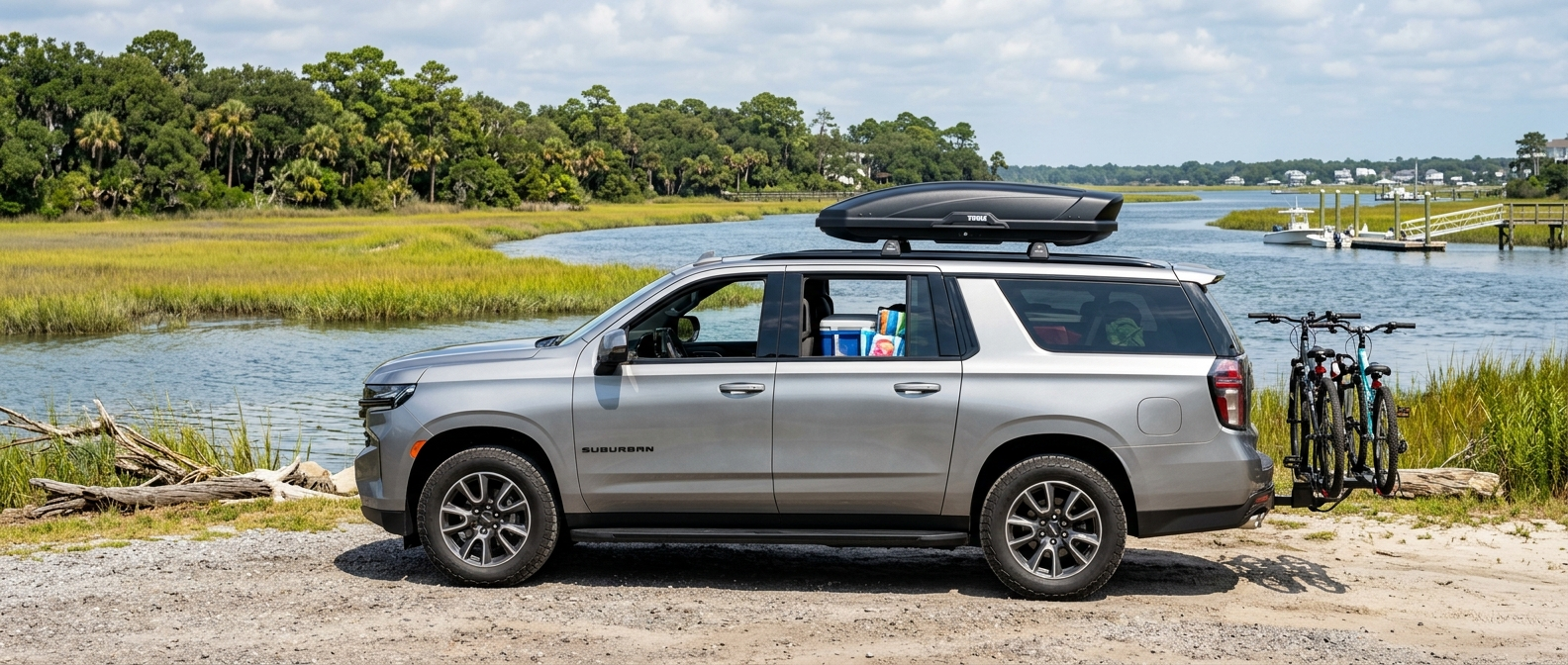
The drive down US-17 from Conway to Charleston looks simple on a map. About 98 miles, roughly two hours door-to-door on a clear day. Then you load seven kids, two adults, a stroller, a cooler, and a week of luggage into the Suburban, and the vehicle that felt enormous in the driveway turns out to carry a few hidden decisions that decide whether this trip runs comfortable or cramped. The bottom line is simple. The 2026 Chevrolet Suburban can genuinely handle a large family on this exact run, but only if you’ve made the right configuration calls before you leave Horry County.
Browse our Suburban inventory at Palmetto Chevrolet and come back to this, because the choices below are the ones worth understanding first.
What’s Actually Going on When the Suburban Feels Tight?
Large-family road-trip frustration with a Suburban usually traces back to three decisions that look minor at the dealership and feel major somewhere around Georgetown on the way south. The table below maps the symptom you feel to the decision that caused it, and what to do about it.
| What the family notices | What’s actually happening | What to do before the trip |
|---|---|---|
| No room for luggage with all seats up | Third row is occupied; cargo bay behind it is only 41.5 cu ft | Evaluate who’s riding and whether row 3 can fold; 93.8 cu ft opens the moment that row goes flat |
| Middle-row passengers can’t reach their bags | Captain’s chairs selected; the pass-through aisle is there but items sit forward | Load a soft bag under row 2 or use the underseat storage on LT and above |
| Fuel stops feel more frequent than expected | V8 running at 15 mpg city / 20 mpg highway (EPA) hits harder in stop-and-go on US-17 entering Charleston | Plan a Georgetown stop; consider whether the diesel makes sense for how often you do this drive |
| Row 3 adults are grumpy after 90 minutes | The Suburban’s third row seats three, but legroom depends on row 2 position | Slide row 2 forward for road trips; adults fit, but tall teenagers need that adjustment made consciously |
| “We only fit 7” confusion | Captain’s chairs in the second row seat 7; a bench seats 8, with certain trims reaching 9 with a front bench | Know your configuration before you sign |
The Real Cargo Math Behind 41.5 Cubic Feet
The cargo number that matters is 41.5 cubic feet, the figure Chevrolet lists behind the third row of the 2026 Suburban, and while that’s genuinely impressive for a three-row vehicle, it’s still about the footprint of a large chest freezer. It still beats what most competitors offer with their third row folded down, but a family of six with real luggage for a multi-day Charleston trip fills it fast. Space runs short.
Fold the third row flat and you get 93.8 cubic feet. That’s the number that changes this vehicle from “we’ll make it work” to “we have room for everything.” The catch is obvious. Fold the row and two passengers lose their seats. For families of five or fewer, this is an easy call. For families of seven or eight, you’re hauling a cargo carrier or a small trailer, or you’re staying very disciplined about what goes in the truck. You pick seats or gear.
Schedule a pre-trip service check at Palmetto Chevrolet if you’re adding a rooftop carrier or trailer hitch. Our service team can confirm your setup is torque-spec’d and ready before you head south.
Engine Choice Matters More on This Route Than Most Families Realize
The standard 5.3L EcoTec3 V8 delivers 355 horsepower and 383 lb-ft of torque. You’ll see the EPA rate it at 15 mpg city and 20 mpg highway in rear-wheel drive.
They’re solid numbers for a vehicle this size, and more than sufficient for a family run to Charleston. The available 6.2L EcoTec3 V8 bumps output to 420 horsepower and 460 lb-ft, the right call if you’re towing a camper or a boat along with the family. The Suburban is rated to tow up to 8,200 lbs properly equipped, so verify your specific configuration against the door-jamb label before hooking up.
The engine worth a second look for families who run this drive often is the Duramax 3.0L turbodiesel, rated at 305 horsepower, 495 lb-ft of torque, and EPA-estimated fuel economy of 21 mpg city and 26 mpg highway in rear-wheel drive. Chevrolet rates the diesel at up to 728 miles of estimated highway range per tank. For a family running Conway to Charleston and back on a regular basis, that efficiency gap is real, and it compounds across a season of trips. The savings add up.
The tradeoff is real. The diesel isn’t on the LS base trim, so you’ll move up to LT or higher to get it, which means spending more upfront to save on fuel over time. Whether that math works for you depends on how often your family makes this kind of run. Your call.
The Chevrolet Tahoe is worth a look if your family is five or fewer. It shares the same powertrains and gives up about 15 inches of length, which makes parking in Charleston’s historic district considerably less stressful.
Schedule Your Pre-Trip Service Appointment
Bench or Captain’s Chairs: The Decision That Changes Everything
Captain’s chairs win for road-trip comfort and a second-row bench wins for raw headcount, so that single choice shapes how everyone rides down US-17 more than almost any other box you check on the order sheet, and it deserves a decision before you fall for a trim or a color. Second-row captain’s chairs give you a wide center aisle that makes getting to the third row genuinely easy. Your kids can move without climbing over each other. You seat seven passengers total in that configuration. A second-row bench bumps capacity to eight. Certain trims can spec a front bench to reach nine (a specific LS configuration decision).
For road trips, captain’s chairs tend to win on comfort and sanity. Each second-row passenger gets their own armrest and some personal space, and on a two-hour run down US-17, that space earns its keep. The bench configuration makes more sense if you’re regularly maxing out headcount and don’t care as much about row-to-row access. It counts.
If your family is six or under, compare the Chevrolet Traverse before committing to the Suburban’s footprint. It seats seven or eight, parks more easily in downtown Charleston, and still gives you three rows of real space.
DIY Pre-Trip Checks vs. Letting Our Team Handle It
The Suburban doesn’t need anything special for a run like this one, but a few quick checks before you leave Conway will keep the Arthur Ravenel Jr. Bridge entrance and everything south of it incident-free, and the smart move is to split them into what you can do yourself and what we should look at.
Check the driveway items first, then let our team catch the rest before you’re loaded and rolling.
Handle these yourself:
- Tire pressure (including the spare). A full load plus the coastal heat of a South Carolina September will put more thermal load on your tires than an empty truck on a cool morning. Chevrolet specifies cold inflation pressure on the door-jamb label. Use that number, not the “max” stamped on the sidewall.
- Fuel level. If you’re in a gas V8, plan your fill before Georgetown rather than hoping something opens conveniently between there and downtown Charleston.
- Cargo restraint. Unsecured items in a Suburban with 40-plus cubic feet of open cargo bay shift under braking. A cargo net or a low cargo barrier behind the third row is a small investment worth making.
Let us handle these:
- Any deferred oil change or tire rotation. A fresh oil change before a long summer trip is the simplest thing to do and easy to skip.
- Brake inspection if you’ve been pulling a boat or camper this season. Towing puts real thermal stress on brake components, and brakes that feel fine around Conway feel different after the grades and stop-and-go of I-526 approaching Charleston.
- Hitch and receiver check if you’re adding cargo to the trailer. Tongue weight limits for the 2026 Suburban run roughly 10 percent of your total towing capacity. On an 8,200-lb setup, that’s about 820 lbs of tongue weight maximum. It’s easy to exceed with a loaded camper and not easy to know without checking.
Frequently Asked Questions
Does the 2026 Suburban have enough cargo room for a large family road trip?
With all three rows in use, the 2026 Suburban offers 41.5 cubic feet of cargo space behind the third row, which is considerable for a fully loaded three-row vehicle, though it will fill quickly for a family of six or more with multi-day luggage. Fold the third row flat and cargo volume jumps to 93.8 cubic feet. For families who need all seats occupied, a rooftop carrier or small cargo trailer is worth planning before you hit US-17 south toward Charleston.
Is the Suburban diesel worth it for the drive from Conway to Charleston?
The Duramax 3.0L turbodiesel is available on the LT trim and above and delivers EPA-estimated fuel economy of 21 mpg city and 26 mpg highway in rear-wheel drive. That’s noticeably better than the standard 5.3L V8’s 15 city / 20 highway ratings. On a single round trip to Charleston and back that difference is modest, but for families doing this run frequently through the year, the diesel’s efficiency and its estimated 728-mile highway range per tank make a real cumulative case. The tradeoff is that you’re committing to a higher trim level to access the engine.
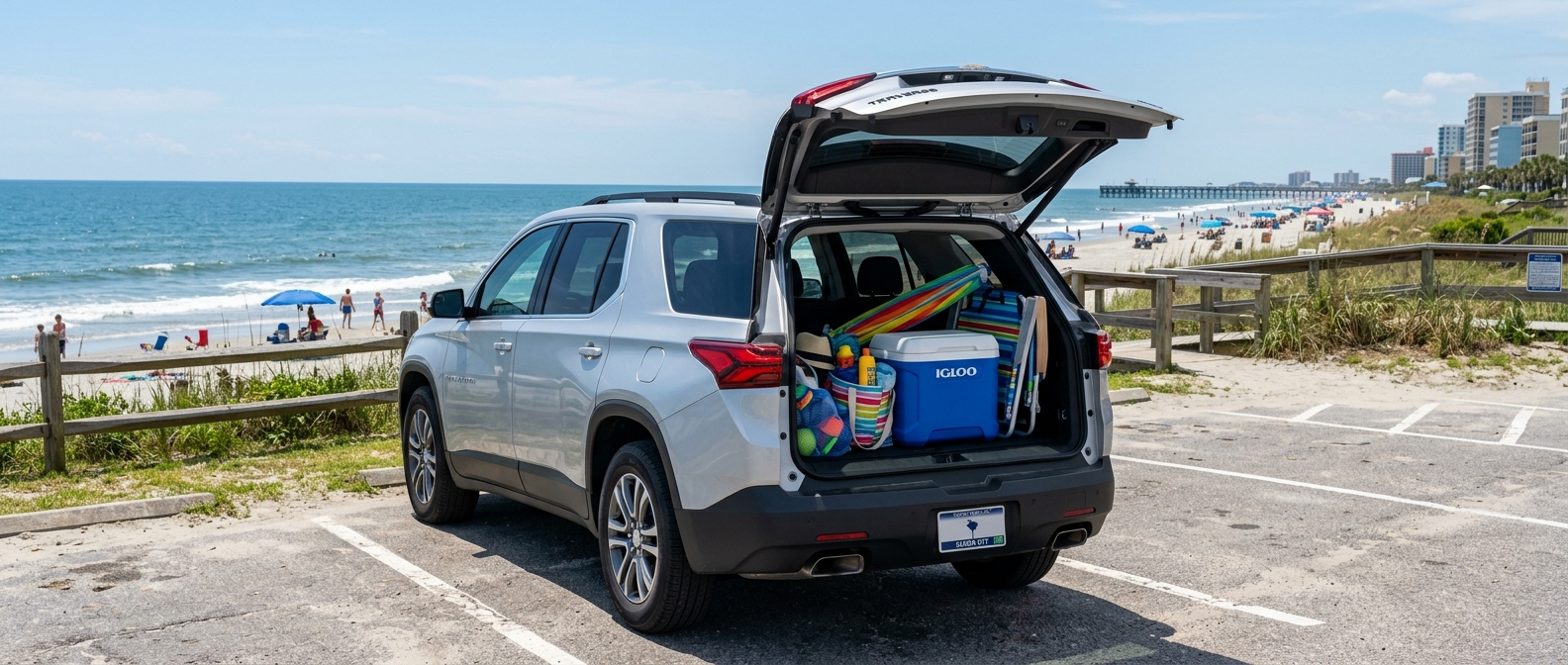
Garden City Pier on a summer Saturday fills up faster than you’d expect. The under-pier lot at 110 S. Waccamaw Drive is real, and it’s convenient, but on a peak weekend it can be gone before 10 a.m. So plan around three things. Arrive early, know your backup lot, and match your SUV to the space you’re walking into.
The 2026 Chevy Traverse is the SUV we see most often headed down Highway 17 toward Garden City with a full family aboard, and for good reason. But it’s not the only answer, and we’ll walk the full breakdown below.
Where Do You Park and When?
You park at the under-pier lot on 110 S. Waccamaw Drive if you arrive before about 9:30 a.m. on a weekend, and you head straight for the Horry County overflow lot if you’re rolling out any later, since the under-structure lot fills from the beach side first and goes fast on a peak Saturday. The honest number is 9:30. Get there before it and the close spot is yours.
| Arrive by | Parking Spot | Fit/Space Note | Insider Tip |
|---|---|---|---|
| Before 9:30 a.m. | Under-pier lot, 110 S. Waccamaw Dr | Tighter pull-through lanes; fits compact and midsize SUVs comfortably; tighter in a Tahoe or Suburban | Face in toward the pier. Backing out is easier when it fills. |
| 9:30 a.m. – 11 a.m. | Horry County lot, corner of Atlantic Ave and Dogwood Drive N | More room; no time limit during open hours (6 a.m. to 2 a.m., no overnight); food truck zone nearby | Short 3-4 block walk north to the pier entrance; easy with a cooler cart |
| After 11 a.m. | Street parking along S. Waccamaw Dr | Slim pickings; golf carts and beachgoers fill spots fast | If you’re circling, go directly to the Horry County lot. Don’t waste time on the street. |
| Any time | Horry County lot as primary | Guaranteed space, free, easier to pull a long wheelbase through | Best call for a Tahoe, Suburban, or a loaded Traverse |
Check the under-pier lot twice before you write it off. The lot is designated for pier customers, and visitors have flagged that golf carts sometimes take up car-sized spaces. If you roll in and the lot looks full but there’s golf cart clutter, it’s worth a patient second lap before heading to the backup.
The Maneuvering Play: Which Chevy Fits Where
Which Chevy fits comes down to length, and the shorter the SUV the easier the under-pier lot gets, though you trade away cargo and seats as you go smaller, so the right pick depends on whether you’re packing light for two or loading a family of six with coolers and canopies. Length matters here more than anywhere on the Grand Strand.
The 2026 Chevy Trailblazer measures 174.1 inches bumper to bumper. It fits the under-pier lot without a second thought, parallel parks on S. Waccamaw Drive easily, and still holds 25.3 cubic feet of cargo behind the rear seats (54.4 cubic feet with the seats folded). The EPA rates the 1.3L FWD Trailblazer at up to 33 mpg highway, so the 45-minute run down Highway 17 from Conway costs you almost nothing at the pump. The tradeoff is fair. You get five seats only, and if you’re hauling tackle boxes, a beach canopy, and two full coolers, you’ll feel the limits of that cargo floor. Pack smart or make two trips.
The 2026 Chevy Equinox splits the difference well. At 183.2 inches long, it still maneuvers comfortably in tighter lots, and Chevrolet rates it at 29.8 cubic feet behind the rear seats (63.5 cubic feet with the bench folded). The EPA rates it at 25 city and 29 highway on the 1.5L turbo. Five adults, chairs, a cooler, and a bag of fishing gear fit without forcing anything. If your group is two adults and a couple of kids with a medium load, the Equinox is the most sensible choice on this list, sized exactly right for what Garden City Pier requires.
The 2026 Traverse is where the equation shifts. Chevrolet lists it at 204.5 inches long (that’s 17 feet of SUV). It parks fine in the Horry County overflow lot where the lanes have room to breathe. In the under-pier tight lanes, you’ll want patience. Go slow. But fold both rear rows flat and Chevrolet lists up to 97.6 cubic feet of cargo. Three rows, up to eight seats, and enough room behind the third row (22.9 cubic feet even with all seats up) for a serious beach haul. Family of six with gear? The Traverse is built for exactly this.
The 2026 Chevy Tahoe runs 211.3 inches long on a 120.9-inch wheelbase. Our advice is straightforward. Treat the Horry County lot as your primary spot, not your backup. The Tahoe’s 122.7 cubic feet of maximum cargo and seating for up to nine people make it the right call for bigger groups and anyone towing a trailer to the nearby Murrells Inlet boat ramps. The 5.3L V8 is EPA-rated at 15 city and 20 highway. Real Grand Strand heat and stop-and-go on Highway 17 will land you toward the city end. The diesel option does better, but either way plan your fuel stop before you hit the beach strip. Park it in the overflow lot, walk the three blocks, and the size stops being a headache.
Your Pre-Pier Checklist Before You Leave Conway
A good day at Garden City Pier comes down mostly to logistics, and the morning prep decides whether you’re on the sand by mid-morning or circling S. Waccamaw Drive at noon, so we’d load, fuel, and time the drive before anyone climbs in, coolers first. We’d run that prep like this.
- Cooler position: Load coolers behind the second row before the kids get in, not after. Rearranging at the lot wastes your good parking window.
- Parking cash or card: The Horry County lot is free; the under-pier lot has no noted admission charge for walking the pier either. Still, have a card handy for the tackle shop or Pier Cafe.
- Shade gear: Bring a compact pop-up canopy or a couple of umbrellas. The pier has benches with umbrellas on the structure itself, but the beach in front fills fast with families on peak weekends.
- Fuel up in Conway: Once you’re on Highway 17 south past Surfside, options thin out quickly. Keep your vehicle in shape before the season ends (a tire, brake, or battery issue on a packed beach road is genuinely disruptive).
- Arrive time: Target the parking window above. Before 9:30 a.m. for the under-pier lot, or head directly to the Horry County overflow lot if you’re rolling out later.
- Fishing gear: The pier rents equipment on-site if you don’t want to haul rods, and fishing does require a small fee. Decide before you load the vehicle whether you’re bringing gear or renting.
- Plan the timing: The pier is open year-round and runs all night for fishing in summer and early fall. If you’re doing an evening trip for live music at Pieradise, parking is easier after 6 p.m. when daytrippers head home.
Schedule a Pre-Trip Vehicle Check
Go enjoy it. The pier at Garden City is one of the better spots on the Grand Strand (free to walk, live music in summer, decent fishing, and far less crowded than the Myrtle Beach strip). Get the right vehicle under you, leave Conway before the traffic builds on 501 south, and it’s an easy day, coolers and all.
If you want to talk through which SUV size fits your family’s regular beach run, our team at Palmetto Chevrolet is at 1122 4th Ave in Conway. We know this road. We drive it too.
People pull into our lot with a version of the same hesitation. They need a truck, they’re looking at the 2026 Silverado 1500, but they’ve talked themselves halfway out of it. “It’s a lot of truck for beach-town driving.” “The gas mileage has to be brutal.” “If I just need to tow my boat a few times a year, isn’t a 1500 overkill?”
We hear that. We also see what’s moving along the US-501 corridor between Conway and Myrtle Beach. Contractors load out for the wave of new subdivisions going up across Horry County, families haul boats down to the Waccamaw River, and homeowners tackle the storm-prep and renovation work that never really stops on the Grand Strand. The Silverado 1500 keeps showing up as the right answer for those lives. The myths are the part that isn’t quite right.
- Myth 1: A full-size truck is overkill for Grand Strand daily life. Reality: The 2026 Silverado 1500 payload of up to 2,260 lbs and crew cab flexibility fit the specific blend of work and family hauling this market actually demands.
- Myth 2: Truck gas mileage makes a daily commute painful. Reality: The EPA rates the 2026 Silverado 1500 with the available 3.0L Duramax Turbo-Diesel at 23 city / 28 highway mpg (2WD), numbers that compete with many midsize SUVs.
- Myth 3: A half-ton can’t handle real work; you need a 2500. Reality: The 1500’s maximum conventional tow rating reaches 13,300 lbs properly equipped, which covers the vast majority of what Grand Strand tradespeople and recreational towers actually pull.
- The bottom line: Configuration matters more than badge. Your door-jamb label (not the headline spec) is the number that runs your job site.
Is a Full-Size Truck Really Overkill Along Highway 501?
Probably not, once you map the truck against what US-501 life really looks like, because this corridor doubles as the main artery for one of South Carolina’s fastest-growing construction markets while it carries beach traffic, and that mix puts real work in front of the truck every day. New residential subdivisions are spreading west of Myrtle Beach into Carolina Forest and beyond Conway, and that activity puts genuine payload demands on the trucks serving it. The 2026 Silverado 1500 carries a maximum payload of 2,260 lbs (Regular Cab, Long Bed, 2WD with the TurboMax engine, per Chevrolet’s published specs), and the Crew Cab configurations that most families and contractors tend to choose still reach 1,940 to 2,260 lbs depending on the build. You won’t bump into that number on a mulch run. You will bump into it stacking bundled shingles or loading a full pallet of pavers for a backyard renovation, and that’s where the 1500 earns its keep.
Browse commercial Silverado configurations at our Work Truck Solutions center
A fair concession lives here. If your regular load is consistently above the 1500’s rated payload or you’re pulling fifth-wheel loads above 13,000 lbs, a Silverado 2500 HD is the right conversation. But that describes a narrower slice of buyers than the myth suggests. For the tradesperson running materials to Horry County job sites, the family towing a pontoon boat on weekends, or the homeowner who needs real bed capacity without a commercial-grade truck payment, the 1500 fits.
| Reality Check | Myth Says | What’s Actually True |
|---|---|---|
| Payload for Grand Strand work | “A 1500 can’t haul real loads” | Up to 2,260 lbs max payload (Chevrolet, properly equipped; verify door-jamb label) |
| Towing a pontoon or bass boat | “You need a 2500 for the boat” | Most Grand Strand recreational boats tow under 8,000 lbs (within the 1500’s range) |
| Daily driving on US-501 | “Too big for stop-and-go” | Crew Cab footprint is consistent with any full-size pickup; the 501’s issue is signal timing, not vehicle width |
| Construction corridor use | “Overkill for South Carolina” | Horry County is among SC’s fastest-growing markets; real work demand exists here |
The Gas Mileage Myth Deserves a Real Number
Truck fuel economy on US-501 is a fair worry, and it deserves a real number rather than a scare story, because the summer stretch between Conway and the Intracoastal Waterway can turn a 10-minute drive into well past 40 minutes of stop-and-go. US-501 connects Conway to Myrtle Beach. The answer isn’t “avoid trucks.” It’s “choose the right engine.”
The EPA rates the 2026 Silverado 1500 with the available 3.0L Duramax Turbo-Diesel at 23 city / 28 highway mpg in 2WD configuration. Those highway numbers make it the most fuel-efficient Silverado 1500 option by a substantial margin, and they compete with a lot of crossovers. The TurboMax 2.7L four-cylinder (the standard engine on most trims) comes in at around 18-19 mpg combined, which is thirstier than a sedan yet nowhere near the fuel-hemorrhage the myth implies. Add the 5.3L EcoTec3 V8 with Dynamic Fuel Management, and cylinder deactivation under light load softens the real-world city hit more than the raw specs suggest.
The tradeoff is real. Diesel adds upfront cost, and if your annual mileage is modest, the fuel-savings math is slower to balance out. We’ll walk through that with you. For someone running the 501 corridor regularly (a contractor making job-site loops, a salesperson with a wide Horry County territory), the Duramax pays back in highway efficiency. For lighter use, the TurboMax keeps things simpler and still avoids the gas-mileage horror story the myth predicts.
Explore Financing Options for the 2026 Silverado 1500
Does “Half-Ton” Mean Half the Capability?
No, the “half-ton” label is genuinely misleading, because it’s a classification that dates back to when payload ratings hovered around that number, and the 2026 Silverado 1500 tows far more than the badge lets on. The 2026 Silverado 1500’s maximum conventional tow rating is 13,300 lbs when properly equipped with either the 6.2L EcoTec3 V8 or the 3.0L Duramax Turbo-Diesel and the Max Trailering Package (per the 2026 Chevrolet Trailering Guide). The 5.3L V8 with the Max Trailering Package reaches 11,300 lbs. Even the TurboMax four-cylinder (the “base” engine) tows up to 9,500 lbs.
What does that look like on the Grand Strand? A pontoon boat with trailer typically runs 4,000 to 6,000 lbs. A loaded bass boat, maybe 3,500 lbs. A tandem-axle equipment trailer with a skid steer for landscaping work runs heavier but often stays under 12,000 lbs total. The 1500 covers that range without complaint. The 2500 territory is fifth-wheel RVs, heavy enclosed car haulers, and loaded commercial trailers that consistently push above 14,000 lbs, a real category, but not the daily use case for most Horry County buyers.
One caveat our team wants you to hear clearly. The headline tow number is a maximum achieved under a specific configuration. Cab style, bed length, drivetrain, engine, trailering package, and actual payload at the time of towing all affect your specific truck’s rating. That door-jamb sticker on the truck you’re considering is the authoritative figure. Ask us, and we’ll pull it.
So What Should You Actually Do Before You Buy?
Figure out your real-world peak load before you settle on a configuration, and match the truck to that number rather than to the badge on the tailgate, because the door-jamb label is what runs your job site once the paperwork is done. Not your average load. Your peak. If you’re a contractor, that’s the heaviest single haul you make during a busy week. If you’re a family, that’s the boat plus the gear plus the passengers on the day the whole crew comes along. Then match engine, cab, bed length, and trailering package to that number, and verify against the door-jamb label on the specific VIN you’re considering.
For most buyers along the US-501 corridor (whether you’re in Conway, Carolina Forest, or making the run toward the coast), the 2026 Silverado 1500 covers the real need. The myths have been doing more work than the truck has had a chance to. Come in and tell us what you’re hauling. We’ll match the configuration to it.
Browse our current 2026 Silverado 1500 inventory online
Frequently Asked Questions
Is the Chevy Silverado 1500 practical for daily driving on US-501 between Conway and Myrtle Beach?
Yes, with the right engine choice. The 2026 Silverado 1500 with the available 3.0L Duramax Turbo-Diesel is EPA-rated at 23 city / 28 highway mpg in 2WD, which holds up reasonably well even in the stop-and-go traffic patterns that US-501 is known for in summer. The Crew Cab configuration also fits standard parking without any special maneuvering, and the truck’s visibility profile is what you’d expect from any modern full-size pickup.
When does it actually make sense to step up from a Silverado 1500 to a Silverado 2500 HD?
The honest threshold is consistent payload demands above the 1500’s door-jamb limit, or regular towing of loads above roughly 13,000 lbs. For recreational towing (pontoon boats, bass boats, standard camper trailers) and the majority of Horry County contractor use involving materials and light equipment, the 2026 Silverado 1500 is rated for the job when properly equipped.
By the Palmetto Chevrolet Team | September 2026
For busy families near Carolina Forest, the 2026 Chevrolet Traverse is built for exactly this commute. Think suburban grid driving between Carolina Forest Boulevard and US-501, summer afternoon thunderstorms that show up without warning, and a back seat full of kids in car seats. NHTSA awarded it a 5-star overall safety rating, Chevrolet lists standard Chevy Safety Assist across every trim, and the interior seats up to eight. It fits the life. But there are real tradeoffs you’ll want to weigh before you commit.
Browse the 2026 Traverse on our lot to see current trim availability.
The Do’s and Don’ts Table: Traverse Driving for Carolina Forest Conditions
Carolina Forest Boulevard tells you a lot about what a family SUV needs here, narrowing from five lanes near US-501 down to two lanes near the elementary school. Add the Grand Strand tourist traffic surging on US-501 through summer, plus afternoon storms that can drop an inch of rain in twenty minutes, and you get a specific set of demands, so here’s what works and what to watch on a family SUV.
| Situation | Do | Don’t |
|---|---|---|
| Carolina Forest Blvd school-zone merge | Use blind-spot monitoring and rear cross-traffic alert actively every pickup | Rely on mirrors alone when traffic compresses to two lanes |
| US-501 tourist corridor backup | Engage adaptive cruise control to hold a consistent gap in stop-and-go | Tailgate; Buckle to Drive won’t shift into gear if your belt isn’t on, so get settled before you’re moving |
| Grand Strand afternoon thunderstorm | Slow down well before standing water; Chevrolet lists standard automatic emergency braking that works at lower speeds | Brake hard and late; the AEB assists but doesn’t substitute for leaving a longer gap in wet conditions |
| Beach gear and sports equipment loads | Load the 98 cubic feet of maximum cargo space behind the front seats, folding rows 2 and 3 | Exceed the door-jamb rated payload; verify your specific configuration’s label |
| Towing a boat or small trailer to the Waccamaw | Use the available trailer package on properly equipped models; Chevrolet lists a maximum tow rating of 5,000 pounds when properly equipped | Guess at the rating. Check the door-jamb label and your hitch’s tongue-weight limit before you hook up |
The One Technique That Actually Changes the School Run
The one technique that changes the school run is working the whole visibility stack, not just the backup camera, and on Carolina Forest Boulevard that habit earns its keep at every pickup when the lanes compress and other SUVs block your sightlines.
Carolina Forest Boulevard compresses from its five-lane section near US-501 to two lanes near Carolina Forest Elementary School. The Traverse’s standard rear cross-traffic alert and blind-spot monitoring matter here more than they do in open parking lots, because you’re often reversing or merging in tight queues with other SUVs blocking sightlines.
- Before you park for pickup, adjust the side mirrors so you can see the lane behind you without moving your head. You’ll use them more than you expect.
- When you reverse out of the pickup line, let the rear cross-traffic alert do its job. It’ll fire before the obstacle enters the camera’s close-range view.
- In wet conditions, you’ll want an extra car length of following distance. The EPA rates the FWD 2026 Traverse at 20 city and 26 highway mpg, which tells you the engine is pulling a real amount of weight. Stopping distance grows in rain.
- Use Teen Driver if there’s a new driver in your house taking the Traverse to school. Chevrolet lists the Teen Driver system as standard, and it produces an in-vehicle report card of speed, distance, and safety-alert events.
We won’t dress up the drawback. The 2026 Traverse did not earn an IIHS Top Safety Pick designation under the IIHS’s tightened 2026 criteria, which raised the bar specifically for rear-seat protection and crash-avoidance performance. NHTSA still gave it a full 5-star overall rating, with 5 stars in both the frontal and side crash tests. That combination is genuinely good. But if rear-seat crash protection is your family’s top consideration, that’s a real factor to weigh, and we won’t gloss over it.
Check out the Equinox if a smaller footprint fits your driveway better
See the Tahoe for families who want truck-based platform capability
Keeping the Traverse Ready for Grand Strand Conditions
The Gulf Coast heat and salt air that define the Grand Strand are real factors for any vehicle, and the Traverse is no exception, so it’ll stay a reliable daily driver here as long as you keep up with a few climate-specific maintenance items. None of it is complicated.
Check the cabin air filters and keep them current, since they clog faster in a humid subtropical climate. Watch tire pressure monthly, because heat expands the air and low pressure stresses the sidewalls on a vehicle this size. Get your wiper blades inspected before hurricane season brings those heavy afternoon storms. Small habits like these add up fast, and they’ll save you headaches over a Grand Strand summer.
A Traverse that’s kept up for coastal conditions stays a dependable daily tool for Carolina Forest life. It’ll serve for years.
Schedule a Service Appointment
By the Palmetto Chevrolet Team | September 2026
The 2026 Traverse fits the Carolina Forest daily routine. It’s sized for a real Grand Strand family, carries NHTSA’s 5-star overall rating, and brings enough active safety tech to handle both the school pickup and the US-501 merge. The tradeoff (no IIHS TSP under 2026’s tightened rear-seat criteria) is worth knowing. Come drive it and decide for yourself.
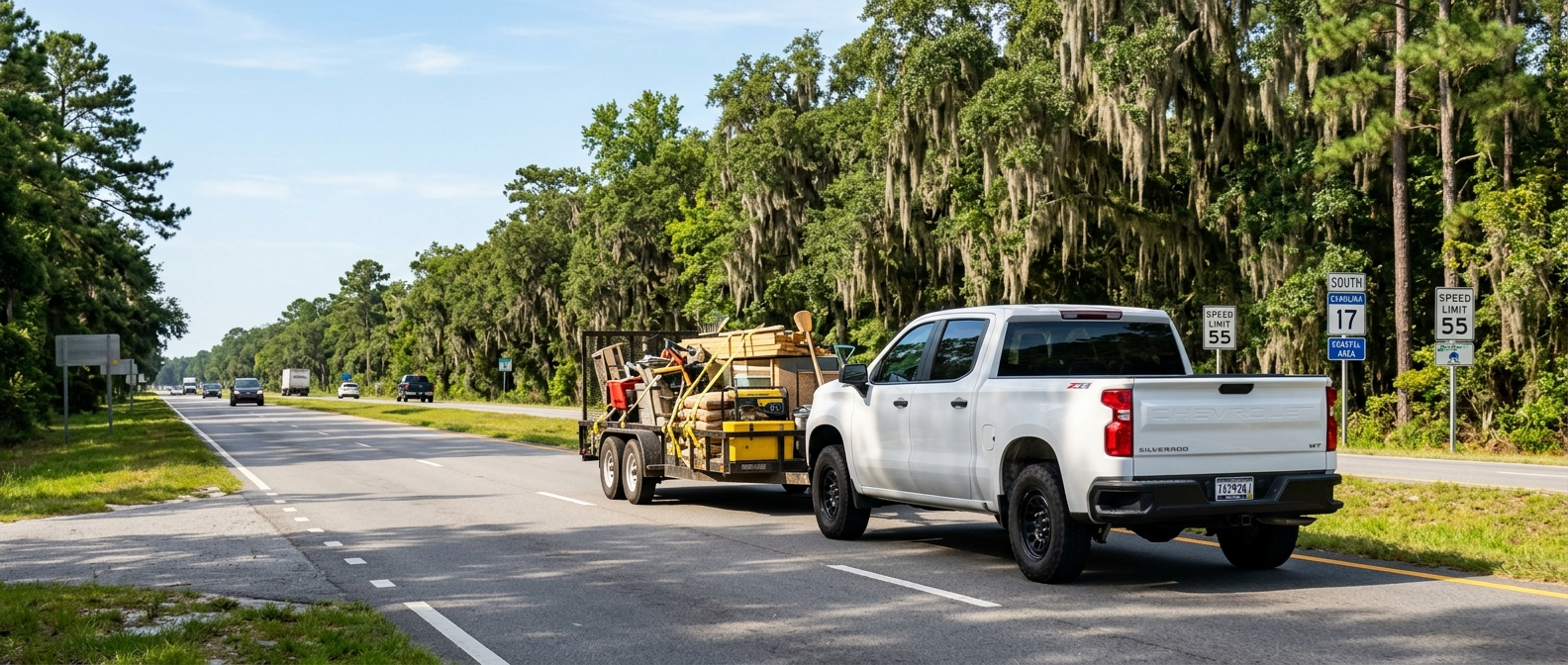
What that trailer weighs decides everything here. A landscape rig loaded with a zero-turn mower and trimmer racks isn’t the same animal as a 14,000-pound equipment trailer hauling a skid steer to a job site off SC-544. Matching truck to trailer is the biggest buying decision you’ll make, so here’s how we rank the 2026 Chevy lineup for Socastee and Horry County utility trailer work.
The pick: If you’re a Socastee tradesperson pulling open landscape trailers or enclosed cargo trailers in the 5,000-to-8,000-pound range, the 2026 Silverado 1500 is your truck. It’s capable enough for serious work and practical enough for the drive home.
2026 Chevy Utility Trailer Towing Rankings
| Rank | Truck | Best For | Standout Spec (properly equipped) |
|---|---|---|---|
| 1 | Silverado 1500 | Landscape trailers, enclosed cargo, light equipment | Up to 13,300 lb towing (Chevrolet) |
| 2 | Silverado 2500 HD | Heavy equipment, dump trailers, dual-axle utility | Up to 18,500 lb conventional (Chevrolet) |
| 3 | Colorado | Single-axle landscape and light utility trailers | Up to 7,700 lb (Chevrolet) |
Every figure here is a Chevrolet-published maximum. Your actual rating depends on engine, cab, drivetrain, and package selection. Check the driver-door-jamb label before you hitch anything.
Silverado 1500: The Workhorse That Actually Fits Your Life
For most Socastee contractors, the Silverado 1500 is where we’d tell you to start, and it’s where the work usually lands. Chevrolet rates the 2026 Silverado 1500 at up to 13,300 pounds of conventional towing when properly equipped with the 3.0L Duramax turbo-diesel or the 6.2L V8 and the Max Trailering Package. That ceiling covers nearly every tandem-axle open landscape trailer or enclosed cargo trailer you’d pull on the Grand Strand. The 2.7L TurboMax four-cylinder, the engine on many work-spec trims, still rates up to 9,500 pounds, which handles the bulk of single- and light-tandem-axle utility setups.
Here’s the honest trade. The Silverado 1500 is the most livable truck day-to-day. You can haul a 6×12 landscape trailer loaded with mowing equipment through the SC-544 interchange at Socastee without drama, then drive it home without feeling like you’re piloting a freight vehicle. When you’re hauling five days a week but the trailer rarely tops 8,000 pounds gross, this truck strikes the right balance.
Silverado 2500 HD: When the Load Stops Being Light-Duty
There’s a real gap between a “utility trailer” in the general sense and a loaded tandem-axle equipment trailer with a compact tractor or skid steer on it. A small skid steer alone weighs north of 3,000 pounds. Add the trailer steel and you’re pushing 7,000 or 8,000 pounds before you load a stick of rebar. That’s where the 2026 Silverado 2500 HD stops being overkill and starts being the correct tool.
Chevrolet rates the 2026 Silverado 2500 HD at up to 18,500 pounds of conventional towing with the 6.6L Duramax diesel engine, and new for 2026, every trim level gets an integrated trailer brake controller standard rather than as an add-on. The gas 6.6L V8 is rated to approximately 14,500 pounds conventional. That integrated brake controller earns its keep on loaded trailers, because you want the trailer’s brakes calibrated in the cab, not from a separate aftermarket unit you duct-taped under the dash.
Now the honest downside. This truck costs more to buy, costs more to fuel, and isn’t the daily commuter you want to run empty on US-501 between jobs. When your utility trailer sits sub-10,000 pounds loaded most of the time, the 2500 HD is buying capability you won’t touch every day. If your trailer regularly runs heavy, buy it and don’t look back.
Colorado: The Midsize Option for Lighter Utility Work
Not every utility trailer is a 7,000-pound tandem-axle rig. A single-axle landscape trailer with a walk-behind mower and a push blower might gross 2,500 to 3,500 pounds loaded. For that kind of work, and for the Socastee contractor or homeowner who occasionally moves materials rather than running a full landscape operation, the 2026 Chevrolet Colorado earns a spot in this conversation.
Every 2026 Colorado runs the same 2.7L TurboMax engine making 310 horsepower and 430 lb-ft of torque, per Chevrolet. Properly equipped with the Advanced Trailering Package, the WT, LT, Trail Boss, and Z71 trims rate at 7,700 pounds maximum. Without that package, the same trims are rated at only 3,500 pounds. That gap is no typo, and it’s the most common spec-sheet trap we watch buyers walk into. Confirm the package is installed before you assume 7,700 is your number.
Near the Intracoastal Waterway crossing in Socastee, the Colorado’s real advantage is maneuverability. Tighter parking lots, narrower access roads on residential landscaping jobs, and the daily stop-and-go on SC-544 all go easier in a midsize. The ceiling is lower. Know your trailer’s gross weight and plan accordingly.
| Pros | Cons |
|---|---|
| Lowest entry point in the Chevy truck lineup | 7,700-lb max requires the Advanced Trailering Package (not standard on all trims) |
| Easiest to maneuver on tight job sites | Can’t grow with you if your trailer needs increase |
| Same 2.7L TurboMax engine across all trims without powertrain surprise | Payload ceiling limits tongue weight headroom |
| Hitch guidance and trailer sway control available | Not the tool for heavy-tandem or equipment trailers |
The Silverado 1500 for Socastee Utility Trailer Work
We keep circling back to the Silverado 1500 as the practical center of gravity for this market, and the reason is the day-to-day math. Horry County tradespeople (landscapers, general contractors, irrigation installers) run loaded utility trailers most of the week, often through high-traffic corridors, in serious summer heat. That last detail isn’t trivial. Coastal South Carolina’s summer humidity means your engine, transmission, and brakes are managing heat stress on every loaded haul. The Silverado 1500’s engine options, the diesel especially with 495 lb-ft of torque per Chevrolet, deliver the low-end pulling torque that controls a loaded trailer without revving into heat territory on a July afternoon pull.
The 2026 Silverado 1500 also tops out at 2,260 pounds of payload capacity, per Chevrolet. That matters because tongue weight, typically 10 to 15 percent of your trailer’s gross weight, comes out of your payload budget. A 7,000-pound loaded trailer generates roughly 700 to 1,050 pounds of tongue weight. The Silverado 1500 absorbs that comfortably. A Colorado running near its payload ceiling doesn’t have the same margin.
Commercial and work truck options through Work Truck Solutions
If you’re not sure what your trailer actually weighs loaded, take it to a public scale before you buy the truck. One trip. It’ll tell you more than any brochure.
By the Palmetto Chevrolet Team | September 2026
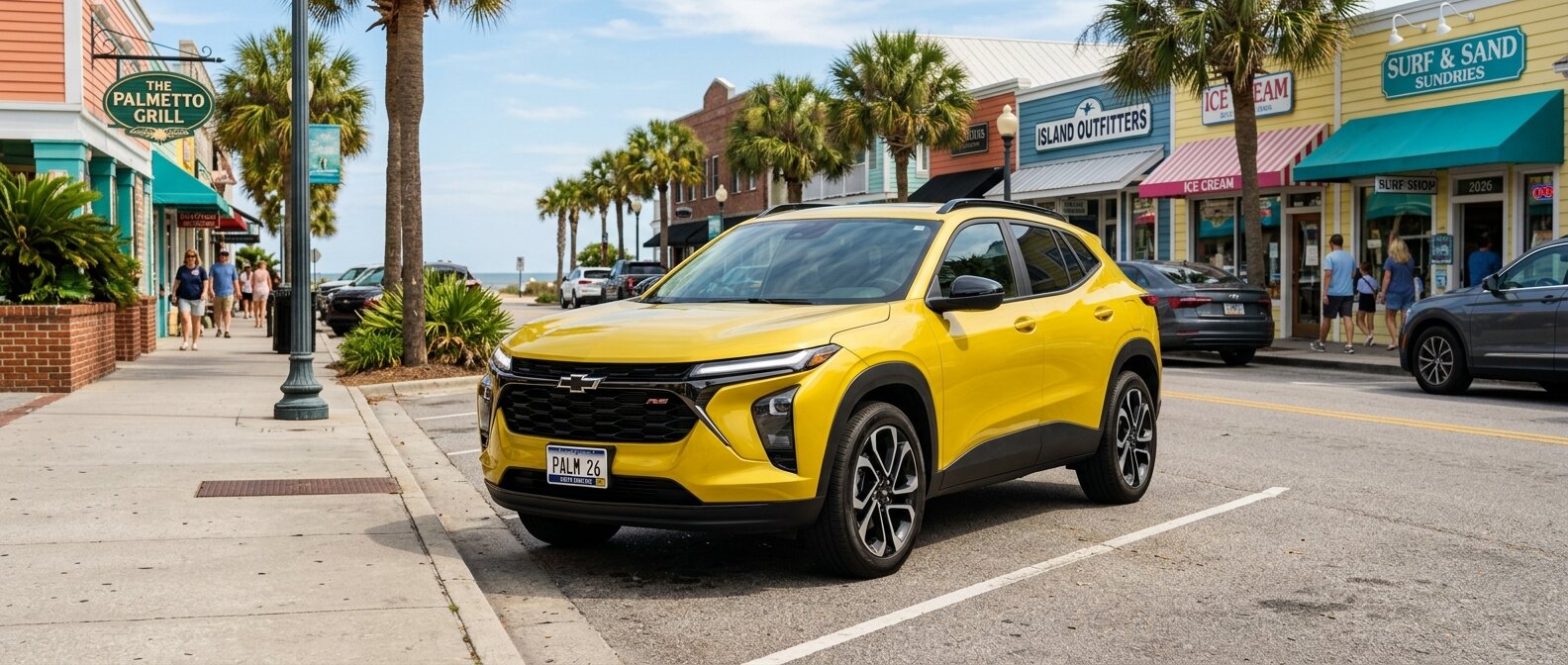
US-501 between Conway and Myrtle Beach is one of the most congested corridors in Horry County. The South Carolina Department of Transportation recorded more than 63,800 vehicles per day on the segment near Carolina Bays Parkway (2023 SCDOT annual daily traffic count), and the widening project that kept crews busy through 2026 means the delays haven’t cleared. A summer run toward the beach that should take ten minutes can stretch past forty. If that’s your daily reality, the vehicle you pick has to fit tight commercial-strip parking, handle repeated stop-and-start cycles without burning fuel it doesn’t need to, and stay honest about where it earns its keep.
The 2026 Chevy Trax is a strong fit for that first pair of demands. Being front-wheel drive only, it asks you to plan a few seconds ahead on a highway merge with a full load, a real characteristic worth knowing before you buy. For the stop-and-go grind of US-501 and the Myrtle Beach grid, though, its dimensions, fuel-saving technology, and standard safety suite make it a truly capable daily tool. We’ll walk you through configuring it so it works the way Chevrolet designed it to.
See the 2026 Trax on our lot at Palmetto Chevrolet
What You Need Before You Start
Pull these specs up before you adjust any settings, because knowing what’s fixed across the lineup saves you second-guessing later. Every 2026 Trax shares the same powertrain across all five trims, which keeps this guide straightforward no matter which one you bought.
| Item | Spec or Setting | Source |
|---|---|---|
| Engine | 1.2L ECOTEC Turbo 3-cyl, 137 hp / 162 lb-ft | Chevrolet |
| Transmission | 6-speed automatic | Chevrolet |
| EPA city fuel economy | 28 MPG (all trims) | EPA |
| Overall length | 178.6 inches | Chevrolet |
| Cargo behind rear seats | 25.6 cu ft | Chevrolet |
| Max cargo (seats folded) | 54.1 cu ft | Chevrolet |
| Rear legroom | 38.7 inches | Chevrolet |
| Fuel tank | 13.2 gallons | Chevrolet |
| Automatic Stop/Start | Standard, every trim | Vehicle infotainment settings |
| Chevy Safety Assist (6 features) | Standard, every trim | Chevrolet |
| Forward Collision Alert sensitivity | Adjustable: Far / Medium / Near | Steering-wheel controls |
| Wireless Apple CarPlay / Android Auto | Standard, every trim | Infotainment pairing menu |
One plain-language note on power belongs here. The 1.2-liter three-cylinder is tuned to make its torque low in the rev range, which makes it pull cleanly from a dead stop. Stop-and-go traffic rewards exactly that. It isn’t the engine you want for a loaded four-lane merge at highway speed. Know the difference and drive accordingly.
Configuring Your Trax for the US-501 Corridor
Give yourself about ten minutes the first time through these six steps, and run them before your first serious beach day so the settings are dialed in when traffic actually hits.
Step 1. Leave Automatic Stop/Start on. Chevrolet installs Stop/Start as standard on every 2026 Trax. The system shuts the engine off when you brake to a stop and restarts it the instant your foot lifts. On a corridor packed with cross-street intersections, like the stretch of US-501 between Conway and SC-544, you can sit through several light cycles per mile. All that idle time is a direct fuel cost. The button on the center console lets you disable Stop/Start for a given drive, and it’s tempting to jab it out of habit because the restart takes a beat to feel familiar. Give it two or three commutes. Once the behavior feels normal, the fuel savings are real and they add up.
Step 2. Tune the Forward Collision Alert before your first congested run. A step up to the Equinox gives you more engine displacement, but the Trax’s standard Chevy Safety Assist suite handles city safety well. The Forward Collision Alert is the one setting worth personalizing. In heavy stop-and-go traffic, the default sensitivity can fire alerts during normal gap closures, and over time that trains you to tune the system out. Use the steering-wheel controls to set it to “Far.” Now the system reads developing situations earlier, so alerts arrive with more lead time and feel proportionate. Medium or Near are fine on open roads. Far is the right choice for US-501.
Step 3. Connect your phone once and let it run. Wireless Apple CarPlay and Android Auto come standard on every 2026 Trax. Pair your phone through the infotainment menu on your first drive, and the connection is automatic every trip after that. On the Grand Strand this matters for one reason, live traffic routing. On a heavy summer afternoon, SC-22 (Veterans Highway) and SC-544 toward Surfside can both move faster than US-501. Google Maps and Apple Maps will show you which in real time. The navigation is only as good as the data it’s pulling, so a connected phone isn’t optional for this kind of driving.
Step 4. Load cargo for sightlines, not just volume. The Trax carries 25.6 cubic feet of cargo behind the rear seats, enough for two beach chairs, a soft-sided cooler, and two bags without stacking. Fold the 60/40 rear seat and you’re at 54.1 cubic feet, which is generous for this vehicle class. The practical discipline for beach-town driving is simple. Stop before the cargo line reaches the rear window. Load smart. The Trax has a standard rear vision camera, and it’s useful, but clear sightlines through the back glass still beat camera-only reliance when you’re backing out of a tight angled spot in a crowded surface lot.
Step 5. Trust the footprint on parking. At 178.6 inches long, the Trax is built for exactly the kind of parking stock that fills Horry County commercial strips. Its turning radius is tight by SUV standards. Downtown Conway side streets, the surface lots along the Myrtle Beach Boardwalk, and the cramped rows near Coastal Carolina University’s campus-adjacent retail are all manageable in this vehicle. They’re a lot less manageable in a Traverse or a Tahoe. If you’ve got a 2RS or ACTIV trim with the Driver Confidence Package, rear park assist and blind-spot monitoring are available. On LS and LT trims, the rear camera and your mirrors do the same work. Use them both.
Step 6. Check tire pressure before any long slow-roll session. Your door-jamb sticker lists the manufacturer’s recommended tire pressure for your exact build (check that sticker, not a generic number). Coastal South Carolina heat affects inflation, so this one’s worth a habit. An underinflated tire builds heat through sidewall flexion, which is the primary mechanical reason tires fail during sustained low-speed driving. Two minutes with a gauge before a beach-day run costs nothing.
Schedule a service visit for a tire-pressure check and full inspection
Print-and-Go Recap
- [ ] Automatic Stop/Start: enabled (resist the console disable button)
- [ ] Forward Collision Alert: set to “Far” via steering-wheel controls
- [ ] Phone paired wirelessly (Apple CarPlay or Android Auto)
- [ ] Live traffic navigation active before entering US-501
- [ ] Cargo loaded with clear sightline through rear glass
- [ ] Tire pressure verified against door-jamb sticker
- [ ] Rear park assist / blind-spot monitoring (2RS/ACTIV trims): active in vehicle settings
- [ ] Fuel level confirmed (EPA city rating: 28 MPG; tank: 13.2 gallons)
Where the Trax Earns Its Place on the Grand Strand
The 2026 Trax answers a specific question well, and the question is which new SUV makes the most practical daily driver for a Conway-to-Myrtle Beach commute or a compact family’s beach-town errands. It’s got a compact footprint, stop-and-go fuel tech, a six-feature safety suite standard at every trim level, and cargo that handles real beach gear. The EPA rates it at 28 MPG city, and that holds up in the driving conditions US-501 actually produces.
If your driving skews more highway than grid, the Trailblazer is worth a test drive alongside it. It’s got more power on the on-ramps and a slightly larger footprint. If you’re moving a family of five regularly, the Equinox steps up in rear-passenger room and adds AWD as an option the Trax doesn’t offer. Know the trip before you pick the vehicle.
Which trip are you actually driving? Answer that first, because for the commuter, the CCU student, or the small family running beach errands out of Conway, the Trax is a practical, well-matched fit. Come drive it down 4th Avenue and see how it feels.
Frequently Asked Questions
Does the 2026 Chevy Trax get good gas mileage in stop-and-go traffic?
The EPA rates the 2026 Trax at 28 MPG city across all five trims. Chevrolet’s Automatic Stop/Start (standard on every trim) cuts the engine at red lights and restarts when you lift off the brake, which directly supports that city rating during the repeated stop-and-go cycles that US-501 between Conway and Myrtle Beach produces.
Is the 2026 Chevy Trax easy to park in Myrtle Beach?
At 178.6 inches in overall length per Chevrolet’s specification, the 2026 Trax is one of the more compact SUVs available new. That footprint fits the angled surface lots near the Myrtle Beach Boardwalk and the side streets of downtown Conway with considerably more margin than a midsize or full-size SUV. By the Palmetto Chevrolet Team | September 2026


